 Kuang Si Falls Tours
Best Time to Visit Kuang Si Falls: Month-by-Month Guide
The best time to visit Kuang Si Falls is December to February, when the water runs turquoise, daytime highs sit at 26 to 29°C and rainfall almost stops. November and March are the strong runner-ups, March trading a little haze for warmer swimming. The window to avoid, if the colour in the photographs is what you came for, is July to September, when the pools turn brown and swimming closes for days at a time. The hour matters as much as the month, and we cover that below too. Once the month is settled, the guided trips we compare are grouped by how much of the day they give you at the park.
Quick answer
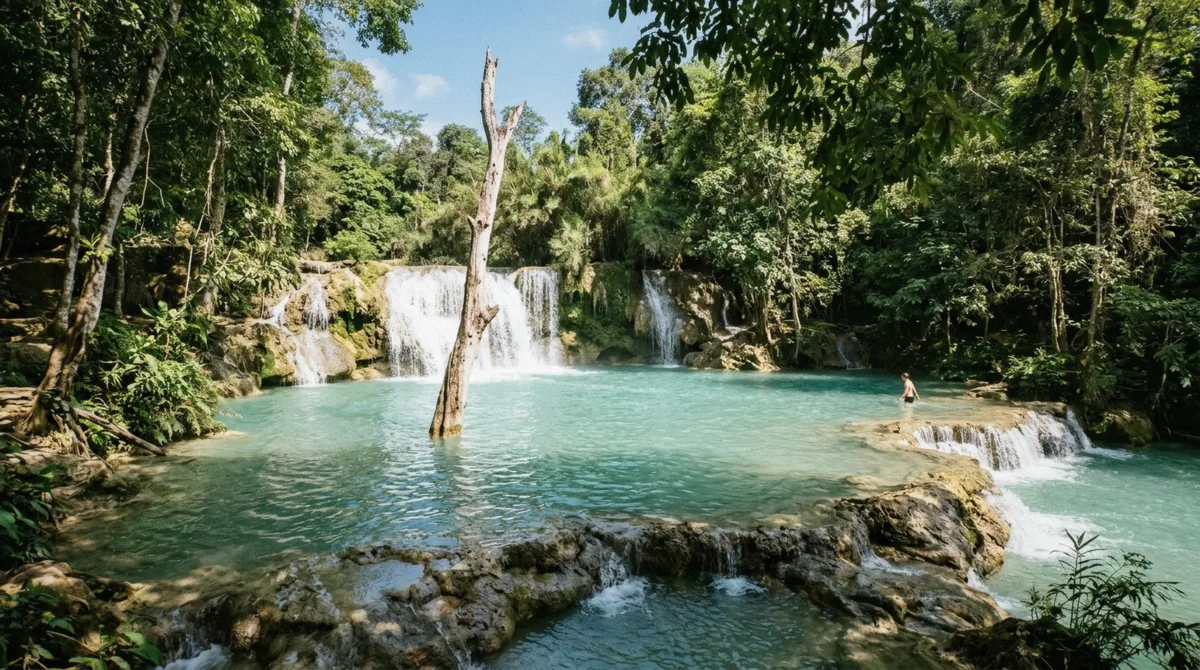
December to February is the best time to visit Kuang Si Falls: the slow flow makes the water its most vivid blue, the air sits at 26 to 29°C and February averages about 14 millimetres of rain for the whole month. This is also the busiest window, so arrive at the 8:00 am opening or after 15:00. July to September brings the most water and the least colour.
Key takeaways
- December to February: bluest water, driest air, biggest crowds. Compare the guided Kuang Si Falls trips
- March and April: still blue, 32 to 33°C, hill-burning haze in the valley
- May to October: high volume, brown water, swimming often closed
- Quiet windows are 08:00 to 09:30 and after 15:00, every month of the year
- The gate opens 8:00 am and closes 5:30 pm, and entry stays 60,000 kip year round
- Afternoon trips land inside the second quiet window by design
Seasons at a Glance
Four windows, four different waterfalls
Kuang Si changes more between seasons than almost any sight in northern Laos. The same limestone chain produces a delicate blue staircase in January and a brown torrent in August. Neither is wrong.
They are just not the same trip.
| Season | Weather | Water | Crowds | Verdict |
|---|---|---|---|---|
| November to February | 26 to 29°C, 40 to 60 mm a month | Turquoise, clear, swimmable | Heaviest of the year | Best overall |
| March to April | 32 to 33°C, building humidity | Still blue, lower volume | Busy, easing in late April | Hot, hazy, good swimming |
| May to July | 31 to 32°C, 280 to 300 mm a month | Rising, turning brown | Thinning fast | Green and loud, gamble on the pools |
| August to October | 30°C, up to 312 mm in August | Brown, powerful, often closed to swimmers | Quietest | For the volume, not the colour |
November to February: the Postcard Window
What these months give you
The rain stops in late October and the river drops through November. By December the flow is slow enough that the calcium carbonate stays suspended, which is what turns the pools that improbable blue, and the water is clear to the stones on the bottom.
Air temperatures are the most comfortable of the year, 26 to 29°C by day, cooler at dawn than visitors expect. The water does not warm up with the air: it surfaces a short distance upstream and stays in the low 20s all year, so the first minute in the pool is bracing in January.
- Daytime highs 26 to 29°C, nights down to 14°C in December and January
- Rainfall 40 to 60 mm a month, and February the driest at about 14 mm
- Swimming reliably open in the lower pools
- Book transport the day before. This is when vans and songthaews fill
March and April: Hot, Blue and Hazy
The trade-off nobody photographs
The water stays blue and the pools drop to their lowest, which some visitors prefer for the shallow terraces. Air temperatures climb to 32 or 33°C, making the swim the point of the day rather than a bonus.
What the brochures leave out is the smoke. Farmers across northern Laos burn the hillsides before the rains, and from late February into April the haze sits in the valley for weeks. It softens every distant view, takes the blue out of the sky and, in bad years, gets thick enough that the ridges opposite The View disappear. If long-lens landscape photography is your reason for coming, this is the window to skip.
Mid-April: Pi Mai
The Lao New Year falls on 14 to 16 April, and Luang Prabang runs the largest version of it in the country. The official holiday is three days, but the town's programme stretches across roughly 11 to 20 April, with processions, a sand-castle competition on the Mekong and water thrown at everyone on the street, visitors included (festival dates and customs).
What that does to a Kuang Si day is straightforward. Domestic travel peaks, so rooms and minivan seats book out weeks ahead instead of days, and you will make the drive out and back wet whether you planned to or not. Pack anything you care about in a dry bag and expect the park to fill with Lao families rather than tour groups. If the water and the light are the point of your trip, aim either side of that window. If the festival is the point, book the room first and treat the falls as the calm half of the day.
Festival dates from the Lao public holiday calendar and the Luang Prabang municipal programme: https://en.wikipedia.org/wiki/Lao_New_Year
May to July: the Rains Arrive
Green, loud, unpredictable
The monsoon builds through May, and by June the falls are carrying several times the dry-season volume. Rainfall runs 280 to 300 millimetres a month across 21 to 25 rainy days, which does not mean all-day rain: it usually means a heavy burst in the afternoon.
Early in the wet season you can still get lucky. Travellers who visited in mid-June have found the pools blue and swimmable. By July the sediment usually wins. The forest is at its greenest, the crowds thin noticeably and the road gets slick on the last stretch.
The climb to the top stops being reliable
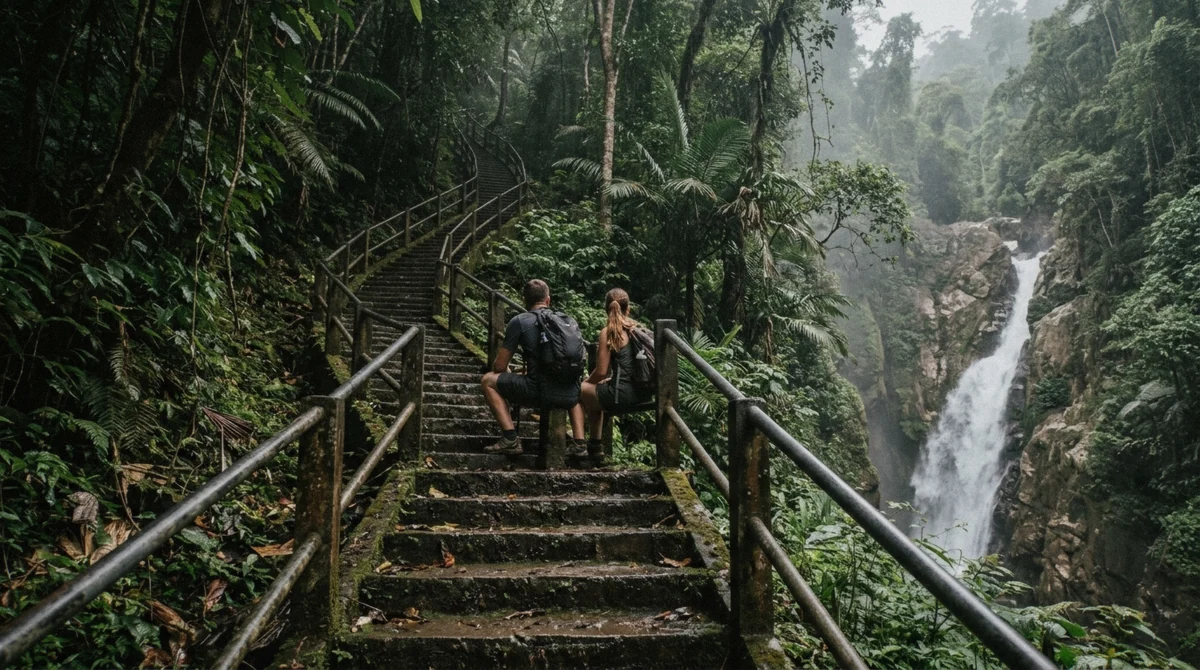
Volume is not the only thing the rain changes. The trail up the side of the cascade is dirt, roots and rock, and once it has been wet for a few days it turns to mud with no grip. Visitors report turning back partway up through the wet months, and after heavy rain the upper section is close to impassable in anything but shoes with a real sole (trail reports).
From roughly June to October, treat the top of the falls as a maybe rather than a plan. The lower terraces and the bridge stay walkable all year. If the climb is the reason you are going, the canal route that comes up the back reaches the top from the far side, and the dry months are the ones to book it in.
Trail condition from visitor reports on the Kuang Si Waterfall Trail: https://www.alltrails.com/trail/laos/luang-prabang/kuang-si-waterfall-trail
August to October: the Powerful Version
The other waterfall
August is the wettest month of the Luang Prabang year, roughly 312 millimetres across about 25 rainy days. The main cascade becomes something you feel rather than photograph: the roar reaches the car park and spray drifts across the bridge.
Swimming is closed more often than not, and when it is open the current in the lower pools deserves respect. In exchange you get the park almost to yourself. One traveller who went in July 2026 reported no crowds at all, and another who went in August, in the rain, still called the waterfall stunning. Rain does not cancel a visit here. It changes what you are visiting.
Month by Month: Temperature and Rain
Luang Prabang climate averages
The falls sit 29 kilometres from town at similar elevation, so town figures are a fair guide to conditions at the park. These are long-term averages rather than a forecast: an individual February can carry a wet week and an individual August can hand you a run of clear mornings.
| Month | Average high | Average low | Rainfall | Rainy days | At the falls |
|---|---|---|---|---|---|
| January | 27°C | 14°C | 45 mm | 5 | Bluest water, coldest swim, busiest |
| February | 29°C | 15°C | 14 mm | 5 | Driest month of the year |
| March | 32°C | 18°C | 70 mm | 8 | Hot, hazy from hill burning |
| April | 33°C | 23°C | 150 mm | 13 | Hottest, and Lao New Year crowds mid-month |
| May | 32°C | 22°C | 280 mm | 21 | Volume rising, colour going |
| June | 32°C | 22°C | 300 mm | 24 | Green and loud. Pools sometimes still blue |
| July | 31°C | 21°C | 290 mm | 25 | Brown water, thin crowds |
| August | 30°C | 23°C | 312 mm | 25 | Wettest month, most powerful cascade |
| September | 30°C | 22°C | 280 mm | 23 | Still high water, greenest forest |
| October | 30°C | 20°C | 140 mm | 13 | Clearing through the month |
| November | 28°C | 17°C | 60 mm | 7 | Colour returning, crowds returning |
| December | 26°C | 14°C | 40 mm | 5 | Cool, clear, excellent |
What Actually Changes the Water
Limestone, not weather
The Nam Si surfaces about 10 kilometres above the falls and runs across white limestone the whole way. Calcium carbonate dissolves out of the rock and stays suspended in the water, scattering light toward the blue end of the spectrum and depositing the travertine shelves the pools sit in.
Slow water holds more of it. That is why the colour peaks in the dry months and why the effect vanishes when monsoon run-off loads the river with soil instead. The counterintuitive part: a single heavy storm can brown the water for a day even in February, and a dry week in September can clear it. The colour follows the river, not the calendar.
Best Time of Day
The crowd clock
The gate opens at 8:00 am and the first hour belongs to whoever got up. Travellers who arrive at 08:45 in peak January routinely have the lower pools to themselves. The first minivans land between 10:00 and 11:00, the large group tours from 11:00 to midday, and by early afternoon there is a queue for photographs on the bridge.
The second window opens around 15:00 as the morning fleet pulls out, and lasts until the 5:30 pm closing. It is warmer for swimming than the dawn slot and requires no alarm, which is why the afternoon trips are timed into it. Weekends run heavier than weekdays in every month, a shift locals date to the opening of the China-Laos Railway.
Fitting in the morning alms round
The alms round in Luang Prabang moves with the season, which is the detail most itineraries miss. It runs earlier through the hot and wet months and later once the mornings cool, and either way it finishes well before the falls open. The park is 29 km from town and 40 to 50 minutes by road, so the two fit into one morning without rushing either of them. The table below pairs each alms window with the departure that still lands you at the gate for the 8:00 am opening.
That is the one morning where taking the dawn slot at the waterfall costs you no extra sleep. Any of the transport options can be timed to it, and a private driver is the easiest to hold at a fixed hour on a morning you cannot move.
| Season | Alms round | Leave town by | At the gate |
|---|---|---|---|
| March to October | 05:30 to 06:30 | 06:50 | Around 07:40, ahead of the opening |
| November to February | 06:00 to 07:00 | 07:10 | Around 08:00, on the opening |
Alms-round hours as practised in Luang Prabang: https://www.rainforestcruises.com/guides/tak-bat-luang-prabang
Best Season by Traveller Type
If You want the photographs everyone else has
December to February, at the 8:00 am opening
If Swimming is the whole point
March to early May: blue water and air warm enough that the low-20s pool feels good
If You hate crowds more than you love blue water
September and October, when the park is quiet and the volume is still impressive
If You are on a tight budget
Wet season. Transport fills slower and prices soften, though the entry fee never changes
If You are travelling with small children
November to February, when the pool edges are calm and shallow
If You shoot landscapes with a long lens
Avoid March and April. The hill-burning haze flattens every distant view
What If the Weather Turns?
Rain is not a cancellation
The park stays open in the rain and the tours run. What rain changes is the swim: a heavy storm upstream browns the pools within hours and can close them the following day. The paths near the top get slick, and an open songthaew becomes an uncomfortable way to travel 29 kilometres.
Every guided trip we list carries free cancellation up to 24 hours before pickup, so the practical move in wet season is to hold a date early and watch the forecast rather than book on the morning. If your window in Luang Prabang is a single day and it rains, go anyway. The falls at full volume are worth the trip. Just leave the swimwear in the bag.
So, When Should You Go?
The short verdict
December to February for the version in the photographs, at 08:00 or after 15:00. March and April if you want to swim in warm air and can live with haze. September and October if quiet matters more than colour.
Whatever month you land in, the choice that changes your day most is how long you get at the park. Trips on our Kuang Si Falls tours page schedule between two and three and a half hours, and the difference between them is bigger than the difference between January and November.
Timing Questions
What time of day is best at Kuang Si Waterfall?
The first hour after the 8:00 am opening, or anything after 15:00. Between 10:00 and midday the park absorbs the whole morning tour fleet of Luang Prabang. The afternoon window is warmer for swimming, and it is the slot the half-day trips are built around.
Which month has the bluest water at Kuang Si Falls?
January and February, when the flow is at its slowest and the water carries the most dissolved calcium carbonate. December and March are close behind. The colour disappears under monsoon sediment from roughly June onward and returns through November.
Is Kuang Si Falls good in September?
Good for volume, poor for colour. September still averages around 280 millimetres of rain across 23 rainy days, so the water is brown and swimming is often closed. The compensation is a park with almost nobody in it and the forest at its greenest.
Should I avoid Kuang Si Falls during Lao New Year?
Only if crowds and logistics matter more to you than the festival. Pi Mai runs 14 to 16 April officially and Luang Prabang celebrates either side of it, which books out rooms and minivans weeks ahead and guarantees you get soaked on the road. The water itself is still blue. Go before or after mid-April if the falls are your priority.
Can you swim in every season?
No. Swimming in the lower pools is reliably open from November to April and closes intermittently between June and September when the current runs too hard or sediment hides the rock shelves. Our swimming guide covers which pools are legal and what closes them.
How many days ahead should you book?
In dry season, a day or two for shared transport and three or four for the guided trips, which are small-group and fill on the popular dates. In wet season you can usually book the night before, though holding a flexible booking early and cancelling free is the smarter play.
Does the entrance fee change with the season?
No. Entry is 60,000 kip per person year round, with children under 120 cm free. Prices at the park adjust with the currency rather than the calendar, and the full fee list has everything else that costs money inside the gate.
When is the park least crowded?
August and September carry the fewest visitors of the year. Within any month, a weekday between 08:00 and 09:30 or after 15:00 is the quietest you will find it, and weekends are consistently busier since the railway from China opened.
The pattern across a year of reviews is stubbornly consistent. People who come in January and arrive at eight leave delighted. People who come in January and arrive at noon leave saying it was crowded.
The month sets what the water looks like. The hour sets what the day feels like.